
WELCOME BONUS 300%
UP TO €2000 + 100
FREE SPINS
UP TO €2000 + 100
FREE SPINS
Home → Blackjack
Blackjack at MaxWin Casino: Variants, Rules and Payouts
Split Aces: Only One Card per Hand
When a pair of aces is split, most tables deal one card to each ace and no further action is allowed on those hands. In the rule set that allows resplitting aces, the house edge falls by 0.08 percentage points, which is the same weight as late surrender in the surrender variant. That 0.08 percentage points means roughly 80 cents saved per €1,000 staked on a table where the option is written into the rules.
The split itself lets a player separate a pair into up to four hands, doubling the original stake with one extra card on each. Splitting aces returns only one card per hand at most tables, so the hands cannot be hit, doubled or split again. A player who expects to build a two-card total on a split ace is working against the standard rule, not with it.
Against a six-deck shoe with a 3:2 payout and basic strategy, the house edge stands at 0.46%. Adding the resplit-aces rule of 0.08 percentage points brings the theoretical edge down to about 0.38%, which on €500 of stakes is €1.90 instead of €2.30. A beginner who splits aces and then tries to hit is making a mistake the rules already forbid.
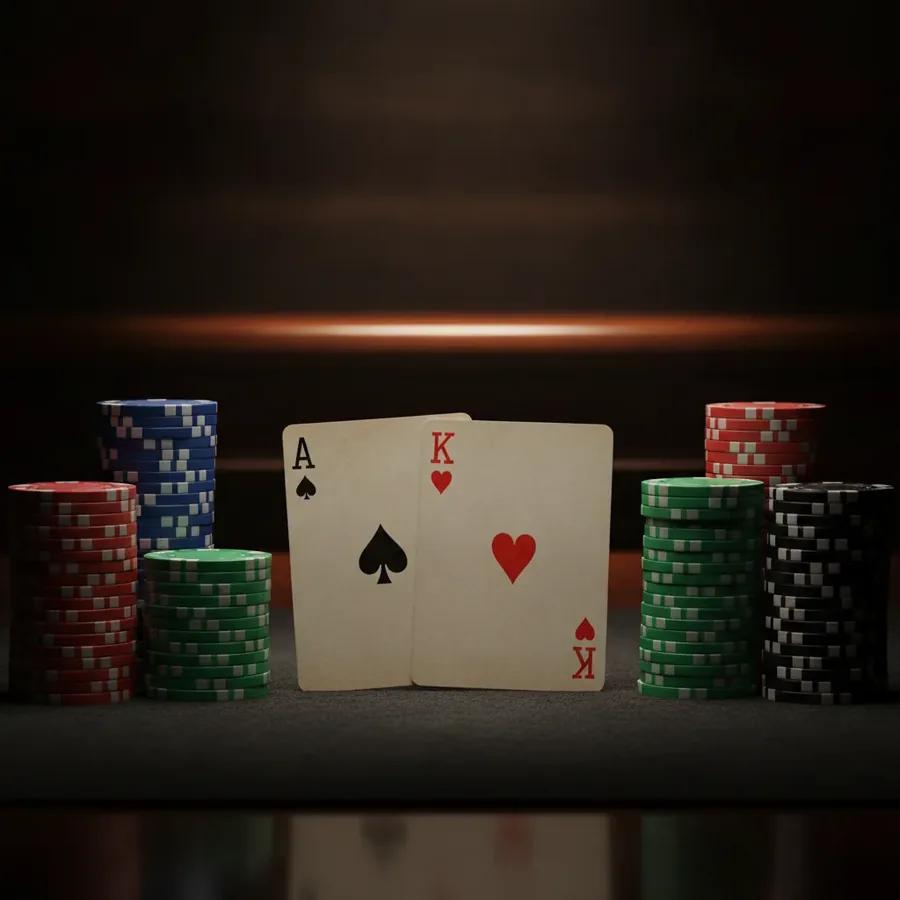
A Side Bet Every Round: The Budget Lasts 30 Rounds
Insurance is a side bet of up to 50% of the main bet, offered when the dealer shows an ace, and it pays 2:1. The house edge on that side bet is 7.47% with six to eight decks, and about 5.88% with a single deck. A €10 insurance bet therefore loses €0.75 per round on average across a long run, which is far above the 0.46% edge on the main hand.
Basic strategy always declines insurance except for card counters at a true count of +3 or higher. Compare that to the main game: the Blackjack 6 decks, S17, DAS, DOA, 3:2 payout, basic strategy variant carries an RTP of 99.54% and a house edge of 0.46%. Insurance at 7.47% is more than sixteen times the cost of the underlying hand.
On a €200 bankroll, taking insurance every round at €5 per bet drains about €0.37 per round, so the budget lasts roughly 540 rounds if nothing else changes. The same €200 placed only on the main hand at 0.46% costs about €0.92 per €200 staked. For a beginner the arithmetic points one way: decline the side bet and keep the budget for the main wager.
Six to Eight Decks in the Shoe
A single-deck blackjack game with classic rules and a 3:2 payout reaches an RTP of 99.85% and a house edge of 0.15%. One deck is about 0.48 percentage points cheaper for the player than eight decks, which is the largest deck-count effect in the standard rule set. That 0.48 percentage points equals €4.80 per €1,000 staked over a long run.
Moving from six decks to eight decks costs about 0.02 percentage points, a much smaller step than the jump from one deck to six. The Blackjack Liberal Vegas Strip variant with S17, DAS, resplit and late surrender holds an RTP of 99.72% and a house edge of 0.28%, showing how rule choices can outweigh deck count. A standard deviation of 1.15 is attached to that liberal rule set.
The classic single-deck figure is often offset in practice by a 6:5 payout instead of 3:2. Replacing 3:2 with 6:5 adds exactly 1.39 percentage points to the casino's edge, more than any other single rule change, and on a €10 bet a blackjack pays €12 instead of €15. A beginner who finds a single-deck table should check the payout line before sitting down.
Doubling After a Split: Which Tables Allow It
Doubling after a split improves the return by about 0.14 percentage points, which is the second-largest rule modifier in the standard set after the 6:5 payout change. The dealer hitting soft 17 lowers the return by 0.22 percentage points, so H17 costs more than DAS gains. On €1,000 staked, 0.22 percentage points is €2.20 lost and 0.14 percentage points is €1.40 gained.
Blackjack Liberal Vegas Strip combines S17, DAS, resplit and late surrender into an RTP of 99.72% and a house edge of 0.28%. The Blackjack 6 decks, S17, DAS, DOA, 3:2 payout, basic strategy variant allows doubling after a split and reaches 99.54% RTP with a 0.46% edge, but offers no surrender. A beginner comparing two tables should look for the DAS line first, because it is worth more than most cosmetic differences.
A double down doubles the stake in exchange for one additional card, and a split can create up to four hands. Late surrender in the surrender variant returns half the stake after the dealer has checked for blackjack, improving RTP by about 0.08 percentage points. Combining DAS at 0.14 percentage points with late surrender at 0.08 percentage points gives roughly 0.22 percentage points of improvement, which offsets the H17 penalty exactly.
Blackjack variants at a glance
| Variant | Payout | House edge | Rule | RTP |
|---|---|---|---|---|
| Blackjack Liberal Vegas Strip (liberal rules, 3:2) | Blackjack 3:2, win 1:1 | 0.28% | The most player-friendly rule set: S17 + DAS + resplit + late surrender. Standard deviation 1.15 | 99.72% |
| Blackjack Insurance (6–8 decks) | Insurance 2:1 | 7.47% | Separate side bet of up to 50% of the main bet when the dealer shows an ace. Basic strategy ALWAYS declines it (except for card counters at a true count ≥ +3). With a single deck the edge is ≈ 5.88% | 92.53% |
| Blackjack 6:5 payout instead of 3:2 (6 decks) | Blackjack 6:5, win 1:1 | 1.85% | Replacing 3:2 with 6:5 adds exactly +1.39 percentage points to the casino's edge – more than any other rule change. On a €10 bet a blackjack pays €12 instead of €15. | 98.15% |
| Blackjack Surrender (late surrender) – rule effect | 50% of the stake returned | −0.08 percentage points | The player gives up the hand after the dealer has checked for blackjack and loses half the stake. Improves RTP by about 0.08 percentage points. Early surrender is worth much more (up to −0.6 percentage points) but is extremely rare. | n/a (rule modifier) |
| Blackjack Single deck, classic rules, 3:2 | Blackjack 3:2, win 1:1 | 0.15% | Fewer decks = lower edge; one deck gives about −0.48 percentage points compared with 8 decks. Often offset by a 6:5 payout. | 99.85% |
| Blackjack Split / double / H17 – rule effects | Double – stake ×2 with one card; split – up to 4 hands; split aces usually get one card each. | H17 +0.22 percentage points; RSA −0.08 percentage points; DAS −0.14 percentage points | Dealer hitting soft 17 lowers RTP by 0.22 percentage points; resplitting aces improves it by 0.08 percentage points; doubling after a split improves it by about 0.14 percentage points; 6 decks instead of 8 – about 0.02 percentage points. | n/a (rule modifiers) |
Infinite Blackjack vs the Classic Seven-Seat Table
Infinite Blackjack from Evolution runs on an unlimited number of seats, with a bet range of 1 - 5,000 EUR and an RTP of 99.47%. A classic seven-seat table caps the number of players who can sit at one layout, so seats are limited and a hand can wait on other players' decisions. The unlimited-seat format removes that waiting, because each participant receives an individual hand against the same dealer cards.
The four side bets in Infinite Blackjack from Evolution are Any Pair, 21+3, Hot 3 and Bust It, and the RTP of 99.47% applies to the main game. A side bet is an extra wager placed on a separate outcome alongside the main hand, and its result does not change the main bet. On a €100 stake, an RTP of 99.47% leaves an average cost of €0.53 per hand over the long run.
Quantum Blackjack Plus Live from Playtech reaches an RTP of 99.57% with optimal strategy, which is 0.10 percentage points above Infinite Blackjack. That gap equals €0.10 per €100 staked, so €1,000 of turnover costs about €4.30 instead of €5.30 on average. Getting the higher return still requires the correct decisions on every hand dealt.
Soft 17: Does the Dealer Hit or Stand?
Blackjack Liberal Vegas Strip uses liberal rules with a 3:2 payout and reaches an RTP of 99.72% with a house edge of 0.28%. Its rule set combines S17, DAS, resplit and late surrender, and the standard deviation of 1.15 describes how widely single-session results scatter around that average. A lower house edge does not remove short-term swings, since variance is a property of the game, not of the rule set.
The dealer hitting soft 17, written as H17, lowers RTP by 0.22 percentage points, so the same six-deck game pays 0.22 percentage points less than under S17. Doubling after a split, or DAS, improves the return by about 0.14 percentage points and resplitting aces by 0.08 percentage points. On €1,000 of stakes, the H17 rule alone shifts roughly €2.20 from the player's theoretical return to the casino.
The six-deck, S17, DAS, DOA game with a 3:2 payout shows an RTP of 99.54% and a house edge of 0.46%, and basic strategy is required to reach that figure. A €10 blackjack pays €15 at 3:2, while the same hand under 6:5 pays only €12. Checking whether the dealer stands or hits on soft 17 before sitting down is therefore worth more than any single betting decision.
No Doubling Down on Three Cards
Doubling down is allowed on any first two cards in the six-deck, S17, DAS, DOA game with a 3:2 payout, which carries an RTP of 99.54%. A double down means the stake is multiplied by two and the player receives exactly one more card. The rule set that reaches this RTP also permits doubling after a split, worth about 0.14 percentage points of return.
Blackjack 6:5 payout instead of 3:2 on six decks returns 98.15% and carries a house edge of 1.85%, so restricted doubling on top of a lower payout compounds the cost. Losing the option to double on three cards removes a decision that adds expected value, because a doubled hand puts twice the stake behind a favourable position. A player betting €10 per hand commits €20 whenever a double is taken.
Blackjack Liberal Vegas Strip combines S17, DAS, resplit and late surrender with an RTP of 99.72% and a house edge of 0.28%. Late surrender lets the player give up the hand after the dealer has checked for blackjack and lose half the stake, which improves the return by about 0.08 percentage points. A €10 hand surrendered late returns €5, so the option is worth using only on the weakest starting hands.
Stop the Session After a 30 Percent Loss
A session stop at a 30 percent loss works on the buy-in: with a €100 bankroll the player leaves the table once the balance falls to €70, which is a €30 loss. On a €200 buy-in the same threshold sits at €140. The rule fixes the loss in euro before the first hand is dealt, not as a feeling.
In blackjack terms that threshold equals roughly 65 hands at a €0.46 house edge on a 6-deck S17 DAS game, since 100 hands at that edge cost about €0.46 per €100 staked. A 30 percent stop therefore absorbs a long downswing without touching the rest of the balance. No rule change can lower that cost below the given edge figure.
Under the 300% welcome bonus up to €2,000 plus 100 free spins, a player who deposits €50 holds €50 + €150 = €200, so the 30 percent stop triggers at €140 of that balance. The stop is a boundary, not a forecast, because RTP is a long-run average over hundreds of thousands of spins.
16 vs 10 played incorrectly: most common error
A hard 16 against a dealer 10 is the hand where basic strategy asks for a hit, yet many players stand instead. The 6-deck S17 DAS game pays 3:2 on blackjack and returns 99.54% with basic strategy, but that figure assumes every decision follows the chart, including this one. Standing on 16 against a 10 lowers the return below the stated 99.54%.
The gap matters in euro: 100 hands at a €10 stake move €1,000 through the table, and the 0.46% edge on the correct play costs about €4.60 on average. Deviating on 16 versus 10 pushes that cost upward hand after hand, because the error repeats in every such spot.
Insurance is the second trap on the same dealer card: the side bet returns 92.53% with a 7.47% edge, and basic strategy always declines it. On a €10 main bet the insurance stake is up to €5, and at 2:1 it pays €10 when it wins. The 7.47% edge against the 0.46% of the main game shows the price of that side bet.
Splitting Eights vs Standing on 16
Splitting eights turns one hard 16 into two hands that each start with an 8, and the split is allowed up to 4 hands. Doubling after a split improves the return by about 0.14 percentage points, while resplitting aces improves it by 0.08 percentage points. On a €10 bet the split puts €20 at risk instead of €10.
Standing on 16 keeps the full stake on a hand that cannot improve, and the dealer hitting soft 17 lowers the return by 0.22 percentage points on its own. Compared with that, the split branch trades a larger exposure for two starting hands of 8, each with its own draw. The 0.14 percentage points from doubling after a split is a separate gain on top.
A 6:5 payout instead of 3:2 adds exactly 1.39 percentage points to the casino's edge, more than any other rule change, so a table with that payout erodes the value of every split decision. On a €10 bet a blackjack pays €12 at 6:5 instead of €15 at 3:2, a €3 difference per blackjack.
What the Hole Card Means at a Live Table
At a live table the hole card is the dealer's face-down second card, checked for blackjack before the player acts on a late surrender decision. Late surrender returns 50% of the stake and improves the return by about 0.08 percentage points, because the player gives up the hand after that check. Early surrender is worth up to 0.6 percentage points more but is extremely rare.
Infinite Blackjack from Evolution runs with unlimited seats and four side bets: Any Pair, 21+3, Hot 3 and Bust It, at a 99.47% return and a bet range of €1 to €5,000. Quantum Blackjack Plus Live from Playtech reaches 99.57% with optimal strategy and carries quantum multipliers up to 1,000x on three-card combinations of 21 points. At a €1 stake that multiplier ceiling is €1,000.
Blackjack Party from Evolution keeps a bet range of €1.00 to €1,000 with two hosts. The hole card is what makes the dealer's blackjack check possible before any player decision, and that check is what separates late surrender from early surrender. Insurance pays 2:1 but lowers the return in the long run.
Contact
Live - online chat
Banking









Providers












MaxWin Casino 2026